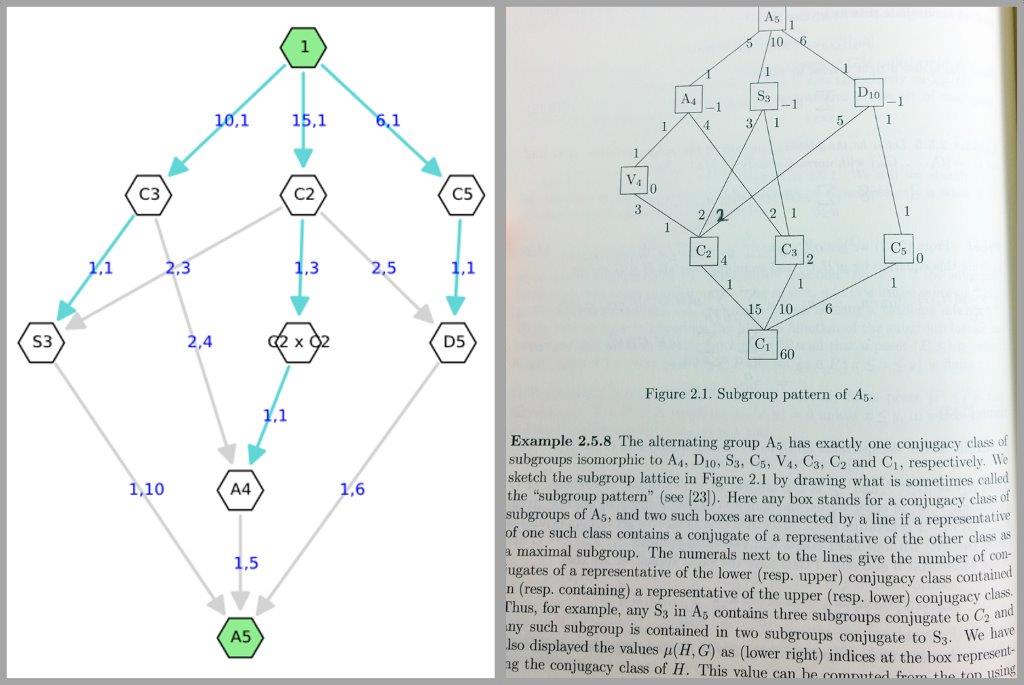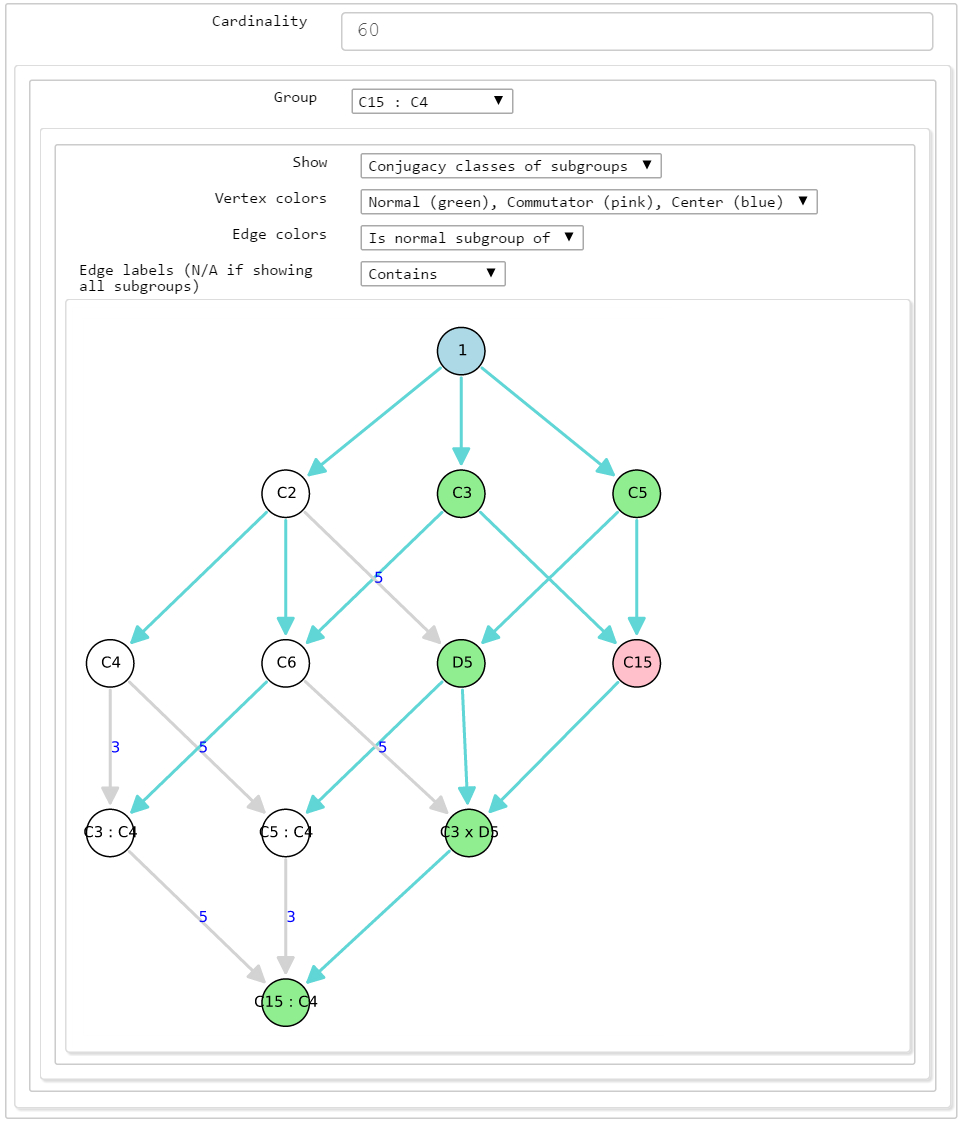
I’ve written an interactive subgroup explorer for all groups of size up to 32. It’s powered by Sage and GAP, and allows you to view the subgroup conjugacy classes of a group from your browser.
Instead of showing the full subgroup lattice, which can get messy for large groups, it only shows the conjugacy classes of subgroups (i.e. all subgroups that are conjugate are combined into a single vertex).
Normal subgroups are colored green. Additionally, the center is blue while the commutator subgroup is pink.
The edge labels indicate how many subgroups of one conjugacy class a given representative subgroup of another conjugacy class contains, or how many subgroups of one conjugacy class a given representative subgroup of another conjugacy class is contained by. The labels are omitted if these numbers are 1. The edge colors indicate whether the subgroups in the “smaller” conjugacy class are normal subgroups of those in “larger” conjugacy class.
In the image above, the group C3 x (C5 : C4) (the colon stands for semi-direct product and is usually written $\rtimes$) contains 5 subgroups isomorphic to C12 and 1 subgroup isomorphic to C3 x D5. The edge colors indicate that C3 x D5 is a normal subgroup of C3 x (C5:C4) whereas C12 is not.
Click Go! below to refresh the viewer, or if it doesn’t load.
Below is the code for a better version that you can run on SageMathCloud. It allows you to input much larger groups. This was used to produce the image at the top of the post. Don’t try running it here, however, since the SageCellServer doesn’t have the database_gap package installed.
Finally, while verifying the results of this program, I found an error in this book!
The correction has been pencilled in. The original number printed was 1.