+John Cook has written a couple of posts recently that caught my eye and they kind of start with this one: Rolling dice for normal sample: Python version.
Go check it out it's pretty cool but basically John Cook shows how to use the Sympy package to obtain coefficients from generating functions in python.
I thought I'd do something similar but with +Sage Mathematical Software System (which is built on python and would be using Sympy on this occasion) but also on a slightly different topic: Semi Magic Squares.
A semi magic square is defined as a square matrix whose row and columns sums are equal to some constant $r$.
So for example semi magic squares of size 3 will be of the form:
$\begin{pmatrix} a&b&r-a-b\\ c&d&r-c-d\\ r-a-c&r-b-d&a+b+c+d-r \end{pmatrix}$
(with $0\leq a, b, c, d, a+c, b+d, a+b, c+d \leq r \leq a+b+c+d$ and $a,b,c,d \in \mathbb{Z}$)
Using this it can be shown that $|\text{SMS}(3,r)|=\binom{r+4}{4}+\binom{r+3}{4}+\binom{r+2}{4}$ (where SMS(n,r) is the set of semi magic squares of size $n$ and line size $r$). A really nice and accessible proof of this is in this paper by Bona: A New Proof of the Formula for the Number of 3 by 3 Magic Squares.
That is however not the point of this blog post :) In fact I'm just going to show the Sage code needed to enumerate the set SMS(n,2).
There's a nice result obtained in A combinatorial distribution problem by Anand Dumir and Gupta in 1966 that expresses the number of elements in SMS(n,r) as a generating function:
$\frac{e^{\frac{x}{2}}}{\sqrt{1-x}}=\sum_{n=0}^{\infty}|\text{SMS}(n,2)|\frac{x^n}{n!^2}$
In the rest of this post I'll now show how to use +Sage Mathematical Software System to get the numbers of Semi Magic Squares of line sum 2 and size $n$.
First of all we need to define the above generating function. In Sage this is easy and as we're going to use the variable $x$ don't need to declare it as a symbolic variable (this is by default for $x$ in sage).
Here's the natural way of doing this:
We can get a plot of $f(x)$ easily in Sage:
which gives:
![]()
To obtain the taylor series (up to $x^5$) expansion of this function we simply call:
Which returns:
Recalling the generating function formulae above we see that the size of $|\text{SMS}(5,2)|$ is: $(5!)^2\times \frac{69}{160}=6210$.
We can use usual python syntax to define a function that will return $|\text{SMS}(n,2)|$ for any $n$:
This makes use of the
To get $|\text{SMS}(n,2)|$ for $0\leq n \leq 10$ we can use:
which gives:
If we throw that sequence in to the OEIS (my best friend during my PhD) we indeed get the correct sequence: A000681 (if you don't know about the OEIS it's awesome, be sure to click one of those two links).
In my previous post today I just used pure Python to carry out simulations to estimate $\pi$ but there are certain things that I find Sage to be better suited for (like generating functions :) ).
In my PhD I looked at a set of objects similar to Semi Magic Squares called: Alternating Sign Matrices.
You can find some of the arguments I briefly talk about here in my thesis (the thought of someone actually reading it is terrifying). I used Mathematica throughout my PhD but (without wanting to sound like a sales pitch) if I had known about Sage (not a sponsor) at the time I would have probably used Sage.
(All the math on this page is rendered using http://www.mathjax.org/ which I'm not entirely sure to have configured correctly for +Blogger; if some of the math hasn't rendered try reloading the page...)
Go check it out it's pretty cool but basically John Cook shows how to use the Sympy package to obtain coefficients from generating functions in python.
I thought I'd do something similar but with +Sage Mathematical Software System (which is built on python and would be using Sympy on this occasion) but also on a slightly different topic: Semi Magic Squares.
A semi magic square is defined as a square matrix whose row and columns sums are equal to some constant $r$.
So for example semi magic squares of size 3 will be of the form:
$\begin{pmatrix} a&b&r-a-b\\ c&d&r-c-d\\ r-a-c&r-b-d&a+b+c+d-r \end{pmatrix}$
(with $0\leq a, b, c, d, a+c, b+d, a+b, c+d \leq r \leq a+b+c+d$ and $a,b,c,d \in \mathbb{Z}$)
Using this it can be shown that $|\text{SMS}(3,r)|=\binom{r+4}{4}+\binom{r+3}{4}+\binom{r+2}{4}$ (where SMS(n,r) is the set of semi magic squares of size $n$ and line size $r$). A really nice and accessible proof of this is in this paper by Bona: A New Proof of the Formula for the Number of 3 by 3 Magic Squares.
That is however not the point of this blog post :) In fact I'm just going to show the Sage code needed to enumerate the set SMS(n,2).
There's a nice result obtained in A combinatorial distribution problem by Anand Dumir and Gupta in 1966 that expresses the number of elements in SMS(n,r) as a generating function:
$\frac{e^{\frac{x}{2}}}{\sqrt{1-x}}=\sum_{n=0}^{\infty}|\text{SMS}(n,2)|\frac{x^n}{n!^2}$
In the rest of this post I'll now show how to use +Sage Mathematical Software System to get the numbers of Semi Magic Squares of line sum 2 and size $n$.
First of all we need to define the above generating function. In Sage this is easy and as we're going to use the variable $x$ don't need to declare it as a symbolic variable (this is by default for $x$ in sage).
Here's the natural way of doing this:
sage: f(x) = e ^ (x / 2)/(sqrt(1 - x))We can get a plot of $f(x)$ easily in Sage:
sage: plot(f(x),x,-10,1)which gives:
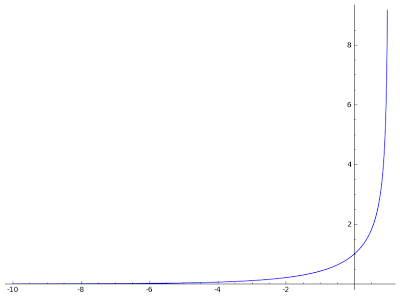
To obtain the taylor series (up to $x^5$) expansion of this function we simply call:
sage: taylor(f(x),x,0,5)Which returns:
69/160*x^5 + 47/96*x^4 + 7/12*x^3 + 3/4*x^2 + x + 1Recalling the generating function formulae above we see that the size of $|\text{SMS}(5,2)|$ is: $(5!)^2\times \frac{69}{160}=6210$.
We can use usual python syntax to define a function that will return $|\text{SMS}(n,2)|$ for any $n$:
sage: def SMS(n,2):
....:    return taylor(f(x),x,0,n).coeff(x^n)*(factorial(n)^2)
This makes use of the
coeff method on the polynomials in sage.To get $|\text{SMS}(n,2)|$ for $0\leq n \leq 10$ we can use:
sage: print [SMS(n,2) for n in range(11)]which gives:
[0, 1, 3, 21, 282, 6210, 202410, 9135630, 545007960, 41514583320]If we throw that sequence in to the OEIS (my best friend during my PhD) we indeed get the correct sequence: A000681 (if you don't know about the OEIS it's awesome, be sure to click one of those two links).
In my previous post today I just used pure Python to carry out simulations to estimate $\pi$ but there are certain things that I find Sage to be better suited for (like generating functions :) ).
In my PhD I looked at a set of objects similar to Semi Magic Squares called: Alternating Sign Matrices.
You can find some of the arguments I briefly talk about here in my thesis (the thought of someone actually reading it is terrifying). I used Mathematica throughout my PhD but (without wanting to sound like a sales pitch) if I had known about Sage (not a sponsor) at the time I would have probably used Sage.
(All the math on this page is rendered using http://www.mathjax.org/ which I'm not entirely sure to have configured correctly for +Blogger; if some of the math hasn't rendered try reloading the page...)